We Allowed This to Happen

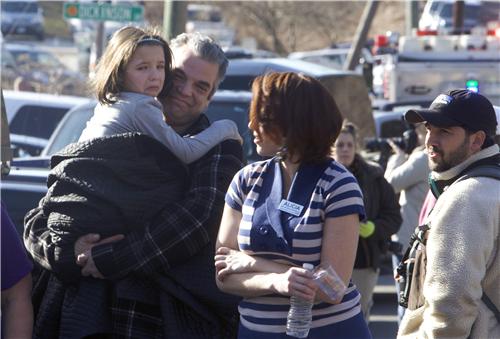
That is all I could think as this horrible story unfolded. Sure, some of us speak up every time a new outbreak of violence occurs while others of us make excuses. But we all settle down afterwards and, in effect, shrug our shoulders. Yeah, there’s some nutcases out there. What are ya gonna do? We’re horrified, and then we get over it, and then it happens again, each incident somehow more senseless — and in an appalling way, less surprising — than the last.

We have decided, as a culture, that these endless massacres are an acceptable price for what we choose to interpret as “freedom.” We’ve decided this because a substantial number of us feel that without free access to weapons, our liberty is not guaranteed — and that any effort to restrict gun ownership is, ipso facto, a direct prelude to enslavement.

We as a culture have to un-decide that.

There are legal remedies that would help prevent these incidents, were they properly enforced. But laws can only go as far as the culture will allow. There is a faction in this country — and yes, I am shifting from first person to third at this point — who have long ago made some kind of accommodation in their hearts to the mass murder of their fellow citizens. I have no problem with hunters who want to be able to take out the occasional deer or pheasant; it’s not my thing, but I don’t begrudge it. I have a huge problem with Second Amendment absolutists who talk tough but who are consumed with fear: of their neighbors, of other races and religions, of their personal existential powerlessness, and most of all, of their government.

It’s dark moments like this that lead me to think the American experiment has failed, and that there really are two distinct and incompatible cultures striving for dominance in this country. One is pledged to the values of the European Enlightenment, embracing one of mankind’s finest inventions — secular representative government — as a means of expanding the potential for success, happiness and progress for all people. The other is permanently stuck back on the frontier, believing that man is essentially ungovernable and that the only liberties you have are the ones you can defend with your own hands.

“We have met the enemy,” satirist Walt Kelly once said, “and he is us.” How is it that the thought of the government taking away your assault rifle is more frightening than the thought of another group of kids being senselessly cut down? How do we stop choosing to let things like Newtown happen?

How pretty is *your* iTunes library?

I am more-than-averagely obsessive about my iTunes library. And yet, this is what most of it looks like. Ever see those pictures of ancient relics being restored in museums, when they’ll have exactly six pieces of some ancient textile and try to somehow fill in the gaps? It’s kinda like that.

Assuming I am more diligent about matching graphics with my albums than most people — and assuming most people acquire their music the way I did, rather than buying it exclusively through iTunes or Amazon — then it stands to reason that most iTunes libraries in the world look like this, or worse.

Kinda depressing, somehow.

24 Cigarettes and One Pipe: Hammett and Chandler

When I was a writing student in college, I came across a how-to manual called The Essence of Fiction, by Malcolm McConnell. It was not like most other writing books I had read before or have read since. My professor, to whom I showed it, was mildly appalled at its strict focus on the mechanics of story construction, and indeed, The Essence of Fiction has no clever exercises a la John Gardener’s The Art of Fiction, nor does it inspire you to live a life devoted to creativity a la Natalie Goldberg’s excellent Wild Mind. Essence is plain and direct and even, to my old teacher’s point, rather crude, but one of its precepts has stuck with me over the years: the rule against cigarette action.

Cigarette action is McConnell’s term for the meaningless physical business a writer will assign a character in order to pace a scene. When writing a dialogue scene, you can’t simply follow one speech with another and then another: it gets fatiguing to read, and the scene gradually loses its sense of place, its physicality. (Not that that stopped Elmore Leonard.) So writers solve this by having their characters do something. Get up and look out the window. Check themselves out in the mirror. Change positions on the couch. And, of course, light cigarettes.

Continue reading

Thanksgiving at Home

Midway through a generous helping of turkey breast, gluten-free stuffing, salad and roasted potatoes, a peculiar realization struck:

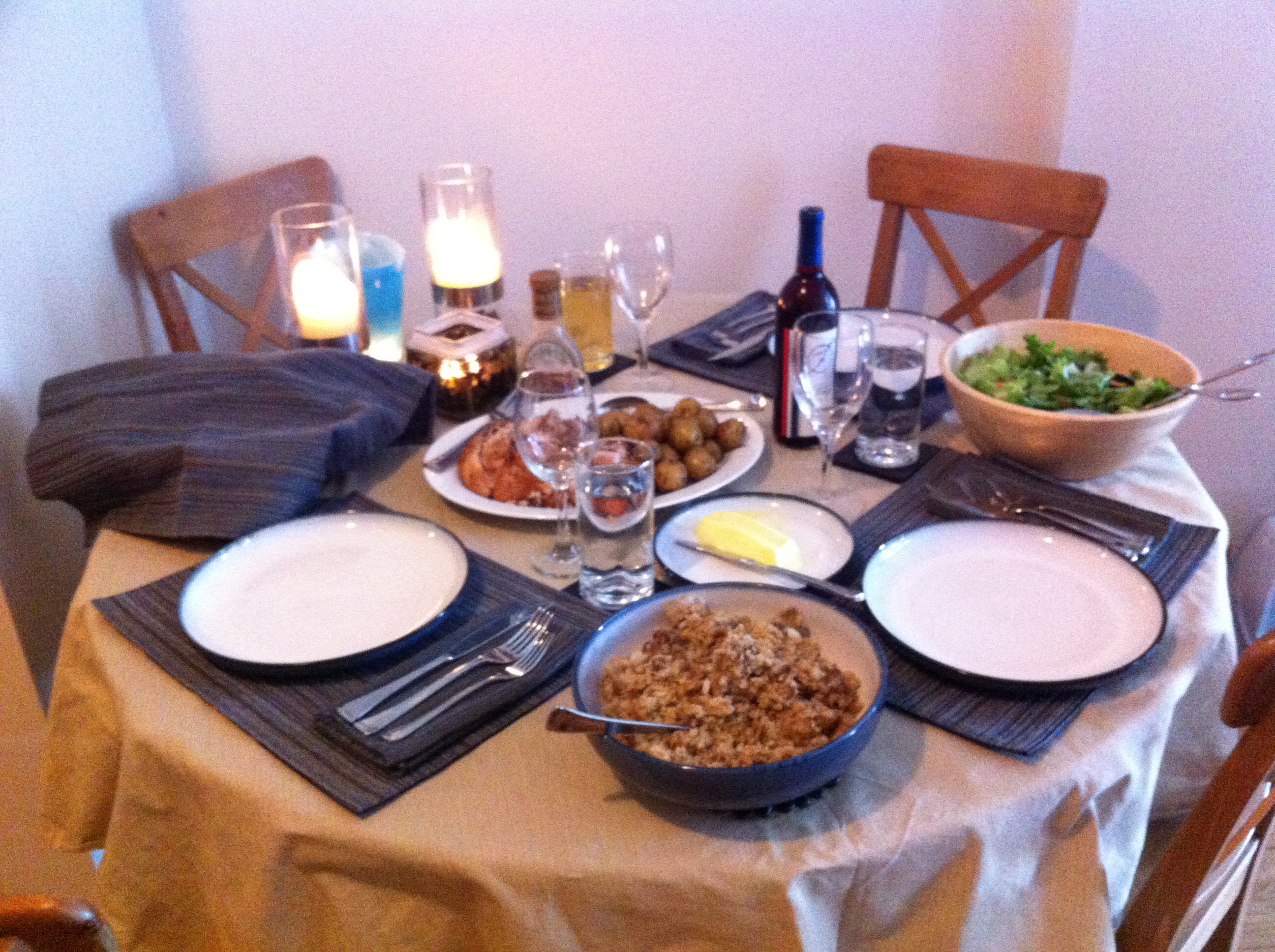
This year was the first time I ever ate a full Thanksgiving dinner in my own home. I never realized how subtly unrelaxed I have been at every previous Thanksgiving celebration until I experienced the ease of having one in my living-slash-dining room. There is a certain satisfaction in celebrating an occasion like this in your own space, with your own things — and of course, with the people you love. I noticed, too, that it made me determined to eat all the more; after all, I had paid for all this stuff.

In the spirit of the season, an incomplete list of things for which I am thankful:

  • My health, such as it is
  • My wife
  • My family
  • My wife’s and family’s health
  • The reelection of President Obama
  • Our cat
  • My brain
  • The music of Bob Dylan, the Beatles, and about a hundred other people and bands; I shan’t bore you
  • Agave

There is more, but those are the highlights. (The couch, for instance, is nice and comfortable.)

Elvis on My Elbow, Dylan on My Calf: Tattoos

Some time ago, I decided to get a tattoo.

There was a time when a statement like that might have inspired anything from a raised eyebrow to a rueful shake of the head to an incredulous gasp, but I confess I have no idea when that time would be. Most likely it wasn’t even within my lifetime. Tattoos are so ubiquitous today as to be something a little worse than banal — they’re predictable. In the suburbs, it’s tramp stamps and tasteful ankle and shoulder decorations; in Chicago, where I live, half-sleeves are apparently the minimum in order to get hired in any restaurant, bar or Apple retail store. Any overtones of rebellion or non-conformity that tattoos might have had are long gone. For a substantial portion of my age group, getting inked is simply an ordinary aspect of becoming an adult, about as out-there as getting a passport.

Back in the ’80s, George Carlin complained that wearing an earring had been drained of all its revolutionary impact: “It was supposed to piss off the squares. The squares are wearing them now!” Likewise, whereas getting tattooed once (literally) branded you as belonging to a group situated a marked distance from mainstream society, today it means almost the opposite, a necessary signifier of a certain urbane, would-be sophistication. It’s strange to think that something as radical as painting your own skin would become common enough to carry a faint whiff of conformity.

This has always presented something of a dilemma for me. I am a non-conformist of the quiet type, meaning I don’t have the balls to chuck my nine-to-five job and become a freegan with a vegetable-oil-powered van, but I do take a quiet pleasure in steering clear of the most egregious fads. Tattooing has reached the point of cultural saturation where my contrariness reflex normally kicks in. I ought to hate the whole idea of it. The proliferation of tattoos today, hundreds and hundreds of them everywhere I go, bothers me. I don’t want to be like these people (even though I probably already am, in more ways than I care to admit) … but then, I don’t want to be like any people. Continue reading

How Hot It Was, How Hot

Summers didn’t used to be like this. As a kid in the suburbs, I would run from the coolness of our front porch into a street warmed to perfection by a sun that never seemed to overstep its bounds. Temperatures tended to hover in the low eighties most days, with the occasional bursts of rain or heat. There were breezes that actually felt refreshing, rather than like blasts from an oven.

This is not nostalgia for the past. A lot of things sucked back then. But in general, the weather wasn’t one of them.

I know this because the kind of hellishly hot days we now experience all the time in Chicago — days when the air lays on you like a searing blanket, thickening your breath, impossible to ignore — were the days I looked forward to as a kid, and there weren’t all that many of them. Hot days were swimming days. When I was young, my neighbors had a pool; later on, we had one. I was never one of those kids who could swim in any kind of weather. Eighty-two degrees is a perfect summer day, but too cool for swimming, at least for a skinny kid with a poorer-than-average ability to regulate his own body temperature. When the weatherman forecast a day in the nineties, it was a treat — it meant there was definitely going to be swimming somewhere, and on a warm day like that, there was no reason to get out of the pool, save for the occasional food and bathroom break. (There is nothing quite like the mix of pleasure and icy agony of going into an air-conditioned house wearing a wet bathing suit on a ninety-plus-degree day.)

Various children of the '80s beating the heat. I'm the kid at center left with the somewhat skeptical look on his face.

I don’t recall precisely when I noticed that this fine homeostatic balance was upset, but I’m pretty sure it was before I had a real understanding of what “global warming” meant. Seemingly all of a sudden, air conditioning went from being an occasional amenity to a vital tool for survival, running for days and even weeks on end. When I began driving, I rarely used my car’s air conditioner: better to feel the wind in my face, I thought, and besides, it’s not that hot out. Now it’s constantly that hot out, and that humid on top of it.

The only consolation we have is that the heat affects pretty much everyone to the same degree. There is a sense, at least on my part, that everyone is in the same boat, dealing with the same back sweat, the same lethargy, the same lingering sense that one should never be outdoors and among strangers while feeling this sticky, smelly and gross. Even with air conditioning, the heat cannot be managed away. It is nature intruding on us coarsely, insisting we give it its due. It’s a little humbling, when all is said and done, and in some lobe of my brain capable of abstract reasoning, I think that’s a good thing. But I still hate the goddamn heat.