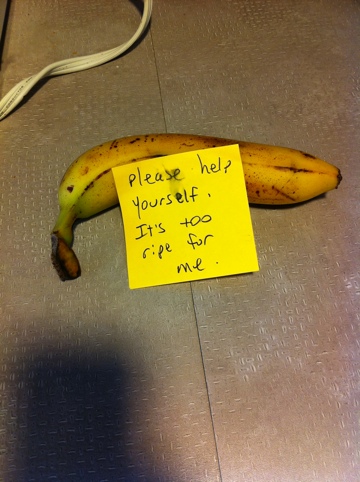
I like to imagine this note was written by the banana, not for it. Simple food offering or subtle cry of existential resignation?

I like to imagine this note was written by the banana, not for it. Simple food offering or subtle cry of existential resignation?
From screenwriter John Rogers:
There are two novels that can change a bookish fourteen-year old’s life: The Lord of the Rings and Atlas Shrugged. One is a childish fantasy that often engenders a lifelong obsession with its unbelievable heroes, leading to an emotionally stunted, socially crippled adulthood, unable to deal with the real world. The other, of course, involves orcs.
Think for a moment what a different world we would be living in if just a single man — Alan Greenspan — had fallen for Tolkien instead of Rand. It’s staggering to contemplate. Hell, even if it had been L. Ron Hubbard instead of Rand, I’m thinking it would be a net win for humanity.
Hat-tip to the Daily Dish.
Your humble blogger was quoted (anonymously*) on The Daily Dish.
(*Honest, that’s me.)
Most of you reading this are probably old enough to remember the launch of Windows 95, even if that event, which took place a scant 14 years ago, seems to belong to another era. It is probably the most widely mainstream manifestation of techno-lust ever witnessed. Stories were legion of people queueing for midnight sales outside of CompUSAs, or wherever the hell people bought their software back then, or having Windows 95 barbecues and just generally getting all giddy about having a Windows that was actually usable. Probably a lot of the stories were made up, but it didn’t seem to matter; for the most part, they felt true. Hordes of people — hundreds of thousands, maybe millions — felt they were getting something new that was going to tangibly make their lives better. That doesn’t happen too often.
Anyway, whether you remember this or not, Microsoft certainly does. Every succeeding version of Windows has launched with an enormous fanfare, an attempt to demonstrate by sheer willpower that Windows is still very much a Big Deal. It’s kind of absurd when you think about it: retail sales of Windows represent only a trickle of the software’s vast currents of revenue. Most Windows installations are licensed to businesses or to computer manufacturers, and most consumers encounter a new Windows version either at work or when they bring home a new machine. It seems silly to expend so much time and money and hope — for these extravaganzas reek of a desire to impress, to delight, to awe — in order to market something that most people are simply going to buy, or otherwise acquire, anyway.
I tend to shy away from comparing Microsoft to the Borg or whatever other evil totalitarian entity strikes your fancy. But it’s hard not to look at a Windows product launch as one would look at, say, the annual pageant given on the birthday of some dictator in a banana republic. It is not enough for Microsoft to dominate, to be the single greatest presence in most people’s computing lives. They want you to love them, too. In Microsoft’s case, the desire is exacerbated by the fact that, for a time, people really did love them — back in 1995, when everyone lined up to buy what is still remembered as the most important consumer software upgrade ever.
Images of khaki-clad guys firing up the Weber must still be playing in Microsoft’s collective head, lo these many years later. How else to explain the company’s strategy for launching Windows 7? Its idea is to encourage people to host software parties, like Tupperware parties except that, presumably, the attendees will include men. Take a look at this, if you can get through it:
I frankly couldn’t. Blandness on that scale is almost beyond parody. I can’t watch that without thinking about those poor actors, hard-working folks no doubt, grateful for a shot at any high-profile gig, reading the script the night before, wondering how in god’s name to inject any kind of humanity or genuine feeling into something so anodyne. Their hearts must have sank anew on arriving at the set and seeing what appears to be a wall-mounted oven straight out of the Brady house. The only thing missing from the scene is Beaver, trotting in to grab a cookie and talk about how he can’t wait to install Windows 7 so he can use it to sync his Zune. It’s a shame Buñuel isn’t alive to see this.
Microsoft’s advertising has always been unusually revealing of the company’s culture, that peculiar brand of left-brainedness that is determined to be hip if only it could find the right algorithm for it. (People thought Jobs was being a snob when he said Microsoft had “absolutely no taste.” As usual, he was more right than most people realized.) There is something autumnal about this piece: it represents Microsoft wistfully and unashamedly reaching back into the past, trying to conjure up some lingering shred of that sunny autumn when the sun never set on Windows 95. Maybe they should look into licensing “Time Is On My Side.”
So iTunes is now selling “Digital 45s.” Now instead of getting simply an old favorite song, you get that song’s original b-side as well, and it only costs you … well, it costs exactly double the price of a single track. But you get nice virtual sleeve art.
I find myself wondering though: will kids too young to remember 45 records understand that the second song is supposed to suck?

This is Linus. I said goodbye to him for the last time today. My mother and I were with him and his last moments were peaceful and free of pain.