Two of my most recent poems, “I Would Be an Ally to You” and “Tell Me Something About You No One Else Knows,” were recently published by Stone Poetry Quarterly. Check ’em out.
Q&A on Carve Magazine
My poem “This Is Not a Story About Me” was just published in the Summer issue of Carve, and as part of the process, I responded to a little Q&A from one of the editors. This is pretty much my first “interview” as a poet, and it took quite a bit of thought to figure out answers to these questions. Anyway, check it out and enjoy.
Talking with Dan Wiencek
My first collection, “Routes Between Raindrops,” is available for purchase
I am thrilled, chuffed and delighted to announce the publication of my first collection of poems, Routes Between Raindrops. It’s available now from First Matter Press and Amazon.
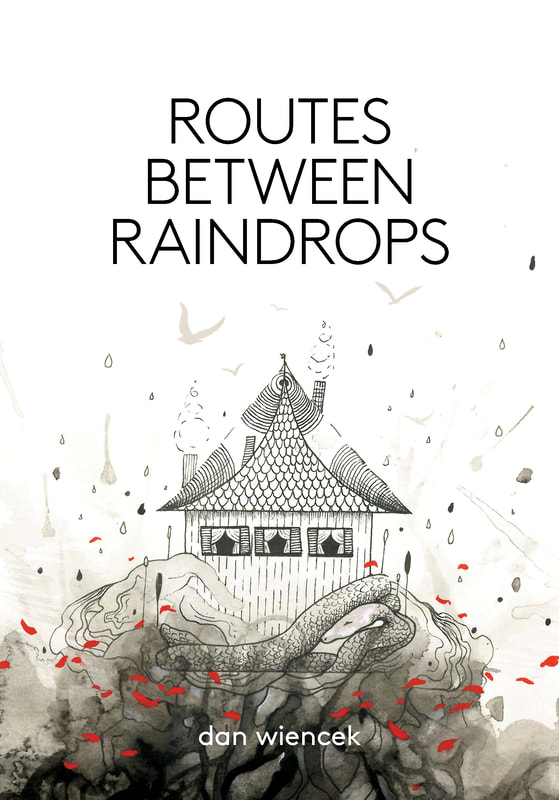
The poems in this book stem mostly from 2016–19, when I joined the Eastside Poetry Workshop here in Portland. A few pieces predate it; one goes back to 2006 or so. The cover art was created by Aleksandra Apocalisse specifically for the book (she was kind enough to add some extra birds for me).
Here is some advance praise, as they call it:
“In ROUTES BETWEEN RAINDROPS, Dan Wiencek searches through a feast of images, what was, what is, and what could have been, as well as what might yet be, as they shift back and forth between the common and the uncanny, the probable and the impossible alike. Wiencek calls us to recognize ourselves, through shifting tones and approaches, from the recognizable, such as baking bread, to the absurd, as in coming home to find a walrus in a pile of laundry or lampshades turning into birds, and all points in between. It’s a marvelously dislocated tour that we exist in, and co-create, as Wiencek writes, ‘Sky throws itself in everyone’s / faces, now you’re me, it says.’”
JOHN GALLAHER, AUTHOR OF IN A LANDSCAPE
“With his slantwise existential wit and his sleight-of-hand association and indirection, Dan Wiencek takes us on ‘a hypothetical guided tour’ through various surreal landscapes all the way to the present moment where you can ‘realize you’re looking at a star,/the mirage that dissolves at the eye’s touch.’”
CLAIRE BATEMAN, AUTHOR OF CORONOLOGY
“I love the way Wiencek perceives the world. Time and again, the speaker in his poems looks out to find it damaged but irresistible, like a friend endlessly returning with some new self-made malady, asking you to love them anyway. And Wiencek does. With a wry, self-aware, and tender humor— the poems put me in mind at times of Tony Hoagland’s— the writer rescues moments from the blur and frames them beautifully: an empty lot “[stares] up at the sun like a vast / gravel eye,”; a hand grasps empty air like “a furnace / starved of flame.”
GRADY CHAMBERS, AUTHOR OF NORTH AMERICAN STADIUMS
Two More Poems
I forgot to post this earlier in the year, but the April 2017 issue of The Blotter featured two of my poems, “Demonstration” and “Walking the Path.” The online version can be read at this link; you can find my work on pages 12-13.
Removing Statues and Planting Trees: Charlottesville and Beyond
This is not an essay denouncing the violence in Charlottesville, or our president’s disgraceful response to it. Those things are self-evident and, to the extent they’re not, others have spoken about them with more eloquence and insight than I could. I want to talk instead about why Charlottesville happened, why it’s likely to happen again and how we might come through this struggle in a better place than where we began.
First, a little background.
This country has never truly reckoned with the consequences of the Civil War and its aftermath—especially, I think, the aftermath, the true, horrid scale of which I believe still remains largely unknown by white Americans; it certainly was to me for most of my life. Jim Crow was more than just laws that kept black people away from the ballot box, a disgraceful enough thing in itself. It was a collusion of culture, politics and the legal system to recreate slavery in all but name, exploiting blacks for their labor while depriving them of everything they were entitled to as newly recognized American citizens. This was done not only through “literacy tests,” grandfather clauses and whites-only drinking fountains but through the convict lease system, consciously racist zoning laws, and of course, vigilante terror and murder, to name just the most obvious things.
The Robert E. Lee statue that was the ostensible cause of all this is a relic of this system. Most of the Civil War statuary dotting courthouses and public squares in Southern towns was not made during the war or in its immediate wake. These figures were erected from the 1900s through the 1920s as totems of Jim Crow, meant to remind both blacks and whites of the level each group occupied (low and high, respectively) on the social pyramid. They are subtle instruments of terror wrought in bronze.
As these monuments began to spring up, there came with them what we now know as the myth of the Lost Cause, the revisionist belief that the Civil War was brought about not by slaveholders determined to protect their human property, but by an overzealous, self-righteous and hypocritical Northern government bent on overrunning the states’ rights guaranteed in the Constitution in order to clear the path for a smothering, all-encompassing Federal authority. The Confederate States of America, a would-be oligarchy founded on racial and religious bigotry and with the explicit goal of expanding slavery throughout the Americas, was recast as a noble-but-doomed final stand in the defense of a now-vanished American ideal.
This historical lie, aided and abetted by whites in the North as much as the South, is why the Stars and Bars remain for many Americans (who often do not consider themselves racist to the slightest degree) a symbol of proud American defiance and self-determination, rather than an emblem of hatred on par with the Nazi swastika. It explains why people wearing the insignia of a defeated insurrectionist movement that sought to leave the Union outright now regard themselves, without irony, as the true patriots and lovers of America. By extension, statues of Lee, Forrest, Longstreet et al, gilded in the patina of the Lost Cause, serve a similar purpose in valorizing this deracinated Confederacy. Civil War statues and the Confederate battle flag are not racist, we are told—they’re our heritage, and no one should be made to feel ashamed of his heritage.
To be sure, the Klan-saluting, torch-wielding crowds protesting in Charlottesville seemed very much motivated by racism, however much they speciously invoked their “heritage.” But these monuments haven’t endured this long solely because of the small minority of Americans who think and act like the demonstrators at Charlottesville. They endure because as a nation we have failed to honestly confront what they stand for—because after all this time, we refuse to agree on what the Civil War meant, or engage with what its post-Reconstruction aftermath set out to achieve.
Until now.
Remember that what prompted this whole appalling display was the Robert E. Lee statue in question was set to be removed from its privileged place, because the leaders of Charlottesville could no longer countenance the insidious ideals that had led to its creation. The neo-Confederates protesting this were lashing out in fear, and their fear is fully justified. The lie upon which they have constructed their pride and sense of worth is being challenged, not just by far-off liberal interlopers but by their own friends and neighbors. People both in the South and beyond it are seeing the myth of the Lost Cause as just that—a fable designed to protect the privileged by obscuring the brutality on which that privilege was founded.
After more than 100 years, the cracks are indisputably beginning to show. New Orleans removed a statue of Lee from public view a few months ago. The Republican governor of Maryland just announced his intention to remove a statue of the Supreme Court justice who wrote the Dred Scott decision. The mayor of Lexington, Kentucky announced—ahead of schedule, spurred on by the violence in Charlottesville—that he intended to have two Confederate statues relocated from the former city courthouse, now a visitor’s center. More cities and states are sure to follow.
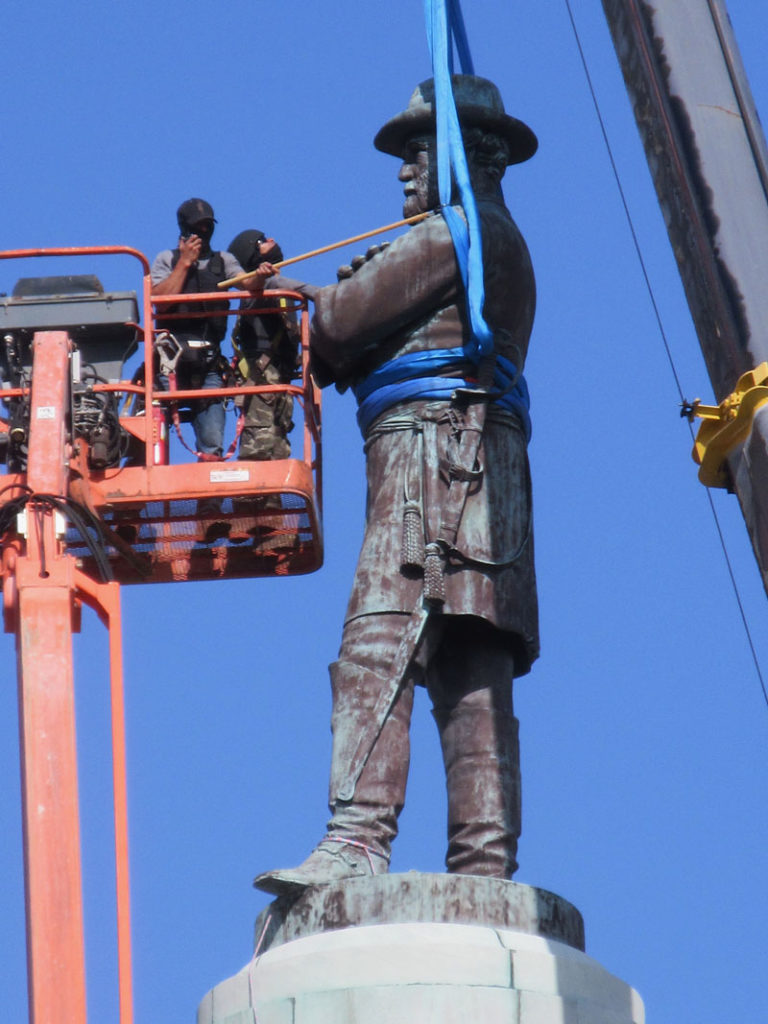
Expect more outbreaks like Charlottesville as the weight of public opinion turns slowly, inexorably against these background furnishings of Jim Crow. It will undoubtedly get worse before it gets better, and it’s perfectly appropriate to be outraged and sickened at these spasms of racist violence, and at the president who responds to them with cowardly equivocation. But the fact remains that this conversation has been long overdue, and having it was never going to be easy. Do you remember when well-meaning politicians used to talk wistfully about the nation “having a dialogue” about race in America? This is what that looks like.
There is a saying among the Chinese: “The best time to plant a tree was 20 years ago. The second-best time is now.” It is tempting—and futile—to wonder what might have been had Reconstruction continued as Lincoln had envisioned it, and Jim Crow and the Lost Cause had shriveled and died before ever having the chance to bloom. But it is not 120 years ago or 20 years ago, and today we are tasked with planting trees in some very hard, stubborn earth. The work will be long and brutal and not all of us may live to see it bear fruit. Yet when it is done—when those seeds have finally taken root and resisted all efforts to pull them free—we can look back at our efforts and our sacrifices and know that they were given in pursuit of a worthy goal, one which, once achieved, will leave our nation better than it was before.
Originally published on Medium.
New Poem, Quick Update [Updated]
As promised in the previous post, a new poem is out. Read “Weighing the Stars” online at Milk Journal.
Update, November 2017: Milk Journal seems to be kaput. Rather than allow the poem to disappear into the memory hole, I am reproducing it here. Pardon the .jpg; advanced online typography is not really my forte.
