Tag Archives: Windows

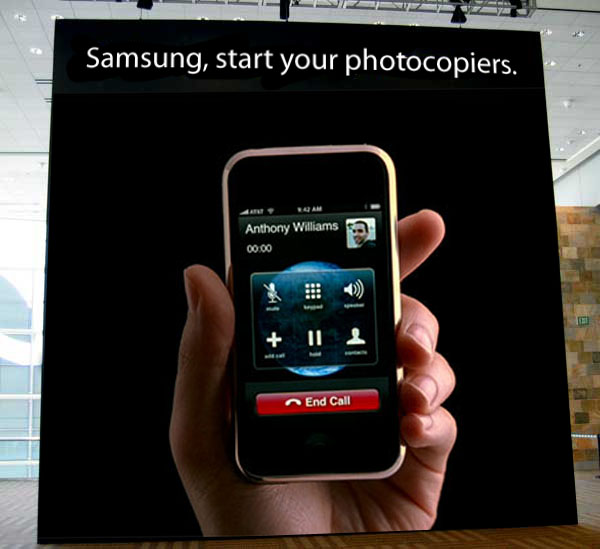
Samsung, Stop Your Photocopiers. (And Apple, Stop Your Lawyers)

“They sat with the iPhone and went feature by feature, copying it to the smallest detail. In those critical three months, Samsung was able to copy and incorporate the core part of Apple’s four-year investment without taking any of the risks, because they were copying the world’s most successful product.”

Thus spake Apple attorney Harold McElhinny to the jury during closing arguments of his company’s lawsuit against Samsung. I don’t think there is any disputing that McElhinny is right. In fact, what reads on the page as lawyer’s hyperbole is really a simple statement of fact: Samsung really did crawl through the iPhone feature by feature, stacking it against its original Galaxy S and concluding that in any instance in which the two devices differed, the latter should adopt the look and functionality of the former. There’s something almost admirable in the very brazenness of it.

What is not so admirable is the spectacle of the world’s most valuable company — not technology company or electronics company, mind, but most valuable, full stop — trying to stamp out one of its imitators not through the competitive marketplace but through the court system. To be blunt, Samsung indisputably copied Apple’s designs, but I don’t see anything in the law that ought to prevent them from doing it.

Certainly, if a company is building knockoff products designed to deceive buyers into thinking they’re purchasing a more popular competing device, that’s a different matter. Tricking people is wrong, in a different way that copying a competitor is wrong; counterfeiters look on those buying their products as marks, not customers. No one is alleging, at least not seriously, that Samsung was trying to trick people into buying its phones by making them think they were iPhones. There was no bogus Apple logo on the back. Anyone with the wattage to purchase and use a cellphone could distinguish between an iPhone and a Galaxy S.

I understand why Apple is undertaking this action. The $2.5 billion in damages the company is hoping to collect from Samsung is a nice chunk of change even by Apple’s standards. Beyond that, a decision in Apple’s favor would cast a collective pall over the mobile device landscape, and that I think is the real goal of this lawsuit. In fact, the actual decision handed down by the jury is probably irrelevant at this stage. Apple has shown the world what it is willing to do to protect its designs — and how much money it is willing to spend in the process. Lawsuits are expensive to prosecute and expensive to defend, no matter how much truth is on your side. No company is going to put itself through what Samsung is doing. Even now, you can bet there are pre-production devices in labs around the world being examined not by engineers but by lawyers, measuring bezels and scrutinizing icons to make sure nothing comes within suing distance of an Apple device. Devices will hit the marketplace designed, first and foremost, not to look like a competing Apple product.

You can see why this situation is a good one for Apple. But is it good for the rest of us? Do we really want a marketplace in which competition is so circumscribed? Does a company that’s already achieved such a sweeping competitive victory really need the machinery of the law to further grind down the other players?

I don’t want any of the above to imply that what Samsung did is commendable. As I said, part of me does admire the sheer ballsiness of it, but far more admirable would be to compete with the iPhone by surpassing it, not imitating it. But companies without originality eventually select themselves for extinction. It may take a while, but if Samsung is as bereft of originality as Apple claims, than Apple has nothing to worry about.

Years ago, Apple sued Microsoft for copying the Macintosh GUI in the first version of Windows. The suit failed because the court ruled that Windows wasn’t precise enough a copy: “Illicit copying,” a judge ruled, “could occur only if the works as a whole are virtually identical,” and similar as Windows was to the Mac, an identical copy it certainly was not. In subsequent years, after Steve Jobs returned and Apple once again assumed a leadership role within the computer industry, the company seemed more sanguine about its inventions being copied, teasing its rivals but otherwise accepting it as the price of innovation. But something happened within Steve Jobs after the iPhone came out. His rivals’ lack of originality was no longer a source of mordant ribbing; it prompted threats to go “thermonuclear” against what he considered “stolen” technology (i.e., Google’s Android operating system). It’s a view that has unfortunately survived him at Apple.

Apple may well win this case — certainly the evidence in their corner is much stronger than it was in the Macintosh/Windows lawsuit. But the mobile computing market will be a poorer place if they do.

Posted in Apple & Tech, Blog | Tagged , , , , , , , , , , , | 11 Comments

Mac OS X: The Lion in Winter

First of all, mea culpa: I was completely wrong about Apple’s pricing strategy for Mac OS X 10.7. That doesn’t bother me — it doesn’t even surprise me that much. I don’t believe Steve Jobs and company are incapable of error, but I do believe they know much more about running their business than I ever will.

But the fact that OS X 10.7 is being released to the public for the measly price of $29.99 (side note: what’s with the double-decimal pricing?) is a huge deal, and not merely because it will likely be the most successful — that is, the most immediately widespread — OS release Apple has ever had. It symbolically closes an era that began 16 years ago with Windows 95: the era of the retail software event. Back then, the country went crazy for Windows 95 in a way that hasn’t been seen since, well, the iPhone came out. People lined up for it, bought it in droves, gossiped and kibitzed and complained about it. A lot of people liked it, a lot didn’t (at least at first), but everybody had an opinion. Windows 95 was more than the tech story of the year: it was the heart of the tech universe, a symbol of how much more than mere technology computer software was becoming. And it was Microsoft’s baby.

I’ve written before about Microsoft’s nostalgia for that era. Each Windows release since then has tried to capture some of that ol’ time OS religion, to steadily diminishing returns. Apple is finally and definitively saying goodbye to all that — and revealing these twentieth-century theatrics for the relic they are. Oh, they’ll make a big deal out of OS X Lion; there will be marketing, commercials, gargantuan enlargements in the windows of Apple retail stores. But there will be no more lines snaking out of those stores, no more giveaway t-shirts and bottles of water handed out to the waiting faithful. Lion is simply a conspicuous stage in an ongoing, iterative process, an inflection point in the otherwise smooth and steady evolution of the Macintosh computing experience. The software itself is a big deal, but acquiring it will not be — in fact, even the time-honored process of installing from physical media seems now a distasteful relic of an earlier age, like handcranking your car to start it.

So what does this mean for the future of the Mac OS? I don’t mean to be one of those discontented types always looking ahead to the next upgrade. I frankly can’t imagine how the operating system will evolve from here. But I do wonder about OS X’s future as both technology and product. When Mac OS X came out ten tumultuous years ago, Apple touted it as the platform that would grow with the Mac for the next decade or more. That decade is up. Could Mac OS X become obsolete? Short of a revolution in computing that obviated the microchip itself, I’m hard pressed to imagine a scenario in which OS X is not the foundation for every platform Apple ships. I’m no developer, but I think the technological underpinnings are sufficiently abstracted that even a kernel rewrite could be brought off relatively smoothly.

So assume that OS X will be with us, in form if not precisely in name, for the foreseeable future. What of Mac OS X the product? When Windows ruled the computing landscape, operating system upgrades were infrequent, ponderous events, accompanied with massive fanfare, scores of helpful books and magazine articles — an entire ecosystem of media and symbiotic technology. Apple changed that model by releasing OS X upgrades, for a time, every year. Eventually Microsoft got the message: you can’t spend seven years fiddling with your software anymore. Now that Apple has ended the era of the retail software release, what else might it dispense with? Does Mac OS X even need milestone updates? I feel quite certain that Steve Jobs finds it distasteful to even bother his users with something so esoteric as software upgrades. Why should you have to know, or care about, the version of the system software you are running? With an electronic app store, it is a simple matter to tag a potential purchase: “The application you have chosen will not run on your computer as it is presently configured. Click here to upgrade your system software and return to this purchase.”

Apple’s WWDC keynote represented a bold step into a new era of computing: one more decoupled, constantly in flux, yet potentially more liberating than anything we’ve yet seen. It’s impossible to say yet what it all means. But the rules have changed, and the future will become ever trickier to predict.

Not that it will stop any of us from trying.

Posted in Apple & Tech, Blog | Tagged , , , , , , , , , , , , | 3 Comments

Jerry and Bill, we barely knew ye

You try to give a beleaguered company some love, and look what happens.

Microsoft is canning its Jerry Seinfeld campaign after airing only two spots. In its place, we are told, is a direct riff on Apple’s “Get a Mac” campaign, in which the “PC” character is recast in a positive light.

Wow. Where to start?

First of all, Microsoft’s protestations to the contrary, there is no way this is part of some preconceived strategy. You don’t invest the kind of money Microsoft did, or hire a spokesperson of Seinfeld’s calibre, to run only two lengthy, opaque spots that never built to any resolution. The only explanation is that Microsoft flinched. The ads got some good notices, but they were far from home runs, and Microsoft’s management must have realized — or believed — that what they had in the can wasn’t going to make things any better.

What’s perhaps most amazing is Microsoft’s counter-assertion, that the whole truncated campaign was a carefully worked out, perfectly executed effort to get people talking and generate buzz, a strategy which has achieved its aim and so may now be ended. If that were really the case — and I don’t believe even Microsoft’s marketers are that stupid — then their shareholders should demand immediate resignations of the company’s chief marketing personnel. To piss away tens of millions of dollars on an idea that turned out to be a dud is, perhaps, an honest mistake; to blow it on a campaign that was designed to be no more than a damp fart from the get-go is criminal. If my shareholder value was being wasted in so cavalier a fashion, I’d want an explanation, and I’d want a few heads on spikes along with it. No one at Microsoft even seems to get this — that the explanation they’re offering actually makes them look worse.

However bad the rest of the spots were — and, assuming they were as good as the ones that did run, they must have at least been watchable — Microsoft should have ran them. The whole campaign had a whiff of desparation about it anyway, but knifing it in the cradle shows the company to be genuinely adrift, feverishly moving from message to message in the hope that something, sooner or later, will stick. At worst, people would complain that the ads were stupid; now, they get to point out that Microsoft actually agrees they were stupid.

That news was quickly followed by the report that the next batch of Microsoft ads would appropriate Apple’s “I’m a PC” meme to rehabilitate the Windows PC. I was willing to give the Seinfeld ads the benefit of the doubt, but I have no hesitation in predicting that these new spots will fail utterly. I’ve said this before, so I’ll confine myself to the short version: you cannot tell people that Windows PCs are great, because people already know they’re not. A lot of people spend the majority of their day in front of one; a lot more have at least one catastrophic story about how Windows or Office made their life hell. Going on TV and pleading, ex-boyfriend-like, for people to remember all the good times they had together isn’t going to get Microsoft anywhere. To confine myself to the even-shorter version: it’s the products, stupid. Microsoft cannot revive its brand by touting products that suck, no matter how clever the spots are.

One day, the Apple/Microsoft Ad War will end up as a case exercise in marketing and advertising texts as an instance of perfect binary opposites: a company that executed almost flawlessly against a preeminent rival too slow and witless to respond. Can’t wait to see what happens next.

Addendum: the new spot has begun airing. A couple of flashes of humor/cleverness, but otherwise, mostly empty air. Reminds me of that staple gimmick they use in commercials for prescription drugs or financial service companies, where a succession of actors recites the same inane catchphrase (“I’m Claritin-clear!” “I’m Claritin-clear!” “I’m Claritin-clear!”). Before it’s halfway done, you’re just waiting for it to be over.

Thanks to Daring Fireball for the original links.

Posted in Apple & Tech | Tagged , , , , , | Leave a comment