On Twitter
- Nobody's shoes squeak as loudly as mine. I must walk wrong. 3 days ago
- Correct twice a day. http://t.co/QPRKHe16 3 days ago
- First pair of glasses in more than 10 years arriving in a few weeks. I am weirdly, dorkily excited about it. 1 week ago
- More updates...
Posting tweet...
-
Recent Posts
- Suit for Hire
- I Know What Conservatives Like. I Know What Liberals Want.
- They Live
- Lordy Lordy.
- Walter Isaacson, Steve Jobs and the Wrong Question
- And My Dream of a Better iPod Takes Another Blow
- If the Beowulf Poet Translated the Ewoks’ Song from Return of the Jedi
- The Unelucidated Facebook Tragedy
Tag Archives: music
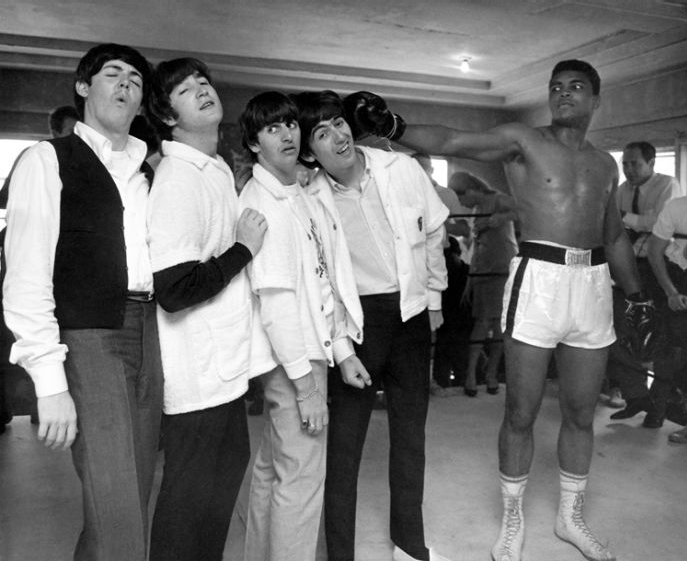
The Beatles Meet Cassius Clay, February 1964
Today Andrew Sullivan’s The Dish linked to a new tumblr called awesome people hanging out together. It lives up to its name. There are classic photos everyone knows, and quite a few I had no inkling of. It’s cool to see Jimi Hendrix greeting Janis Joplin (I can’t link to the photo itself) backstage — for all I know it’s the first time they ever met. Maybe the only time. Or Michael Jackson pretending to punch Mr. T — honestly, can you will yourself not to click that link?
One thing I was expecting to find, and did, was this:
There are lots of pictures of the Beatles clowning around with Cassius Clay, as he was still known then, and this one and the variations of it are the best known. It might not occur to you on seeing it that the Beatles and Clay had no idea who each other were. The photo opp was arranged by their respective handlers, who had some inkling of what it might mean to bring these two phenomena together: the British invaders who were taking over American popular music, and the African-American dynamo who, not content to redefine the sport of boxing, went on to create the template for mass-media sports celebrity — he had already started doing it when this shot was taken.
We see this photo now and marvel that it happened, that these five people ever occupied the same space together. It’s like an improbably real version of those cheesy prints that show Bogart, James Dean and Marilyn Monroe hanging out in the same pool hall. The Beatles and Muhammad Ali, to give him his proper name, are titans, figures who stand outside of popular history. It looked a little different to viewers back then. The Beatles were a teenybopper fad in February 1964, when they went to visit Clay as he trained for his first title fight. No one, perhaps not even the Beatles themselves, realized how pivotal their presence would be as the 60s took their strange, epochal course. And Clay was something of a nine-day-wonder himself, a braggart expected to have his clock cleaned by Sonny Liston. Probably a lot of people simply wanted it to happen, wanted to see the loudmouth get his comeuppance, just as a lot of people waited, and waited, for the Beatles to fall on their faces and prove how shallow and fleeting their presence in the culture really was.
But the Beatles went on to prove that rock music could expand beyond anyone’s preconceptions, taking politics, manners and culture along with it. And Ali proved not only that he was a great fighter — indeed, that he was as great as he said he was, which hardly seemed possible — but that a sports figure could be just as culturally radical, just as transformational, as any artist, politician, philosopher or pop musician.
It hadn’t happened yet. No one was seeing it coming. This is a photo of the moment before the plunge — before everything changed.
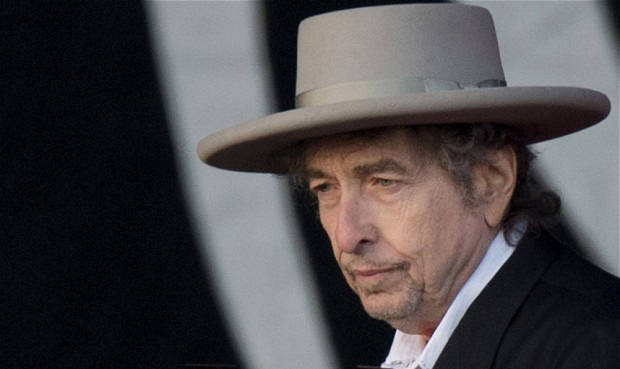
Song and Dance Men: Dylan at 70
The old man enters the club and finds his place at a small table near the stage, taking a seat opposite an empty chair. He is short, wiry, and diminutive and a little absurd in his black embroidered cowboy shirt and dark pants. His thin face is sheltered by a wide-brimmed hat; beneath a long nose is etched a pencil mustache. The eyes, when they emerge from beneath the hat brim, are narrow and seem pressed into a semi-permanent squint; it might be tempting to call them sad, but for the way they swiftly and piercingly take in their surroundings. They dart to and fro through the club, noting the mostly empty tables and the waning daylight streaming in through a solitary window, before settling on the stage, where the evening’s first performer is ambling toward the microphone.
He is young, almost child-like, with round cheeks and curly close-cropped hair. Dressed in jeans and a coarse denim shirt, clutching a guitar with unclipped strings winding off the tuning pegs like whiskers, he might be mistaken for a roadside ragamuffin, but the grin gives him away, even more than those babyish cheeks do: a grin of knowing impetuousness, a charmer’s grin, a grin that knows luck is on its side, or fate or destiny or whatever you choose to call it. Yet how to account for the contrast between the puckish demeanor and the voice? How does someone barely distinguishable from the average small-town twenty-year-old — for it is apparent to the keen observer that the hardscrabble mannerisms are an affectation, given away with a subliminal wink — sing so forlornly, so emphatically and so unaffectedly of things he could never have experienced? The words he sings are infused with the morality and vision of an Old Testament prophet, strained through the vocabulary of an itinerant brakeman. He chides and insinuates and accuses and finally takes it all back onto himself: Ah, but I was so much older then. Always his voice prowls among the words like a hunter nosing for prey in the rocks, investigating dark corners, overturning and exposing hidden things, ignoring what lies in plain sight. It remakes old sayings and never utters the same word in the same way. Not a conventionally attractive instrument, but one that seems to say, Would I be saying these things, in this way, if they weren’t true?
This performer soon gives way to a new face — and the transformation is shocking. In place of the fresh-faced, Jimmie Rodgers-like troubadour now stands a dandified Mod in a tight-fitting striped suit, a wild nimbus of hair radiating from his head like sunbeams, his sallow face guarded by a pair of dark glasses. But the most noticeable transformation — before he starts to sing, that is — is the Fender Telecaster guitar slung high on his chest. He begins to pick at it tentatively, his long-nailed fingers not quite used to the guitar’s weight and action. From the shadows, he is joined by four other musicians, and this ensemble explodes into a roaring barroom blues, tough and loose and fearless, that batters the walls of the club. The gangly singer steps to the microphone and cuts loose in a voice like a police siren amplified through a Marshall stack; he howls, wails, croons, giggles, moans, an unfathomable conviction undergirding everything and holding it together. The words are as arresting as the voice — in fact, the words don’t seem as though they could be delivered any other way. There are torrents of imagery, as though a hundred years of newspaper headlines, shared memory and tall tales were compressed into some cultural singularity before bursting out again, coalescing into a fractalized landscape where Beethoven, Jack the Ripper and Ezra Pound rub elbows with gamblers, old widows, strutting commanders-in-chief and the unnamed lost and lonely. There is jarring silliness, surprising pathos and mystifying juxtapositions of time and place. And most piercing and memorable is a question, thrown out to the audience like an unanswerable taunt: How does it feel?
The audience who are witness to this onslaught — the club is now packed — are left breathless as the performer rushes off stage, irrepressibly energetic to the last. Now nursing a pale drink, the old man near the stage nods, though the gesture is at least as much in wonder as in approval or sympathy. His attention seems to waver a small degree as the next performer comes up. Less sallow-looking, more contented than his predecessor, this singer leads a lean country ensemble through a series of weird, off-kilter parables that give way to more conventional, even mawkish ballads. The audience is intrigued but not quite with him; a few spectators begin to trickle out. The next performer galvanizes the crowd with searing, heartfelt songs of breakup and loss: If you see her, say hello. After him, as the evening lengthens into deep night, a succession of new singers ascends the stage, each one a bit older than the previous, a bit more undirected and less compelling. There is the Christian singer, at first accommodating and then increasingly strident and condemning; the hopeful ’80s pop star, sounding lost amid reams of dated arrangements; an aging folk-rocker delivering almost willfully inconsequential songs; and, in a strange echo of the day’s first performer, an older man with just an acoustic guitar, scratching out folk songs and ballads with a voice from which nearly all the contours have been shaven away. These are performances without irony, taking each song’s outlandish truths and fanciful occurrences as read. I rode all day and I’ll ride all night and I’ll overtake my lady. Whatever he is channeling, it fails to reach very far — the club has grown mostly empty now, and many of the people still present are lost in conversation, reliving and debating what they have already heard earlier in the evening.
The stage light dims, the last performer shuffles off to scattered applause, and for a long time it seems as though there will be no more music here.
Then the old man rises from his table. He adjusts his hat, fiddles with it some more until it’s nested back in the same spot before he started fussing with it. And then he climbs onto the stage.
He sits at an electric piano. From behind him a lonely electric guitar picks a frail chord on every beat. He leans into the microphone.
I’m walking … through streets that are dead.
The audience, distant at first — they have heard much tonight that either disappointed or baffled them — gradually allow themselves to be taken in, surrendering to the words, and to this music that sounds piped in from some juke-joint of the subconscious, every dive bar anyone ever imagined rolled into a single place. The sound as it unfolds picks up and reconciles most of what was great from everyone who came before on this stage: the snatches of quasi-remembered standards, the competing stories telescoped into one fractured narrative, the unabashed humor, the taint of Biblical judgment and overhanging doom. Your days are numbered and so are mine. The loss within these songs is overwhelming, every turn of a corner revealing another ghost, yet despair never overtakes them — or the singer. The man plays on, crouched behind his keyboard, barreling through one song after another, untwisting each one in new and unexpected directions. The playing has taken on a new meaning, here in the waning minutes of night: the act of performing itself, the perseverance to faithfully deliver these words and these melodies is an ennobling one. The perseverance and devotion are the antidotes to despair. As the set at last winds down — I feel a change comin’ on, and the last part of the day is already gone — the man finally brings his gaze from some indeterminate point in space to rest on the faces turned to him. “Thank you.” And out of nowhere a grin, wicked and impish. And then he’s gone, the final chord still ringing in the air.
The sun has returned to the solitary window overlooking the floor, revealing seats that are nearly full again, with both new listeners and those who have sat here stubbornly for what must feel like ages, accepting the mediocre and the execrable as the occasional, and inevitable, price of the sublime. The stage light once again dims. All that remains is the audience, restive yet still miraculously willing to keep their place as they watch the empty stage for whatever is going to happen next.
Posted in Articles, Sketches
Tagged bob dylan, bob dylan 70th birthday, folk music, music, rock music
Leave a comment
My New iPod. (Please, Apple?)
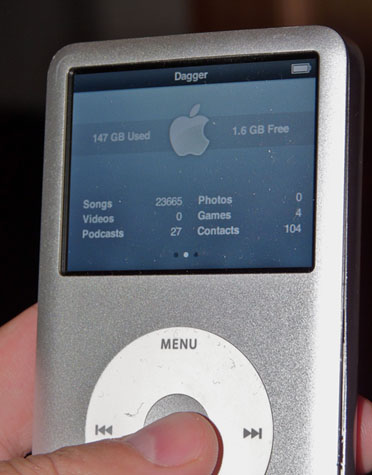
Recently my 160 GB iPod classic began showing signs of advanced age. I would fully charge it, play it a bit, leave it to the side for a day and return to find the battery nearly depleted, sometimes so low it wouldn’t turn on. I began to think it was time, that this device had finally reached the point where it could be allowed to retire gracefully.
I bought this iPod, my third, shortly after the “classic” designation was first introduced. I was thrilled: this was the first iPod large enough to hold the entirety of my music collection, freeing me from the burden of curating playlists and trying to second-guess what my tastes would be on a given day. (I have largely re-assumed this burden with my 32 GB iPhone, but that is another matter.) It did not trouble me at the time that, merely by calling its former flagship product a “classic,” Apple was signaling that the iPod’s glory days as a music device were behind it. A classic is something beyond the need for evolution or change, something that provides the same pleasures over and over, something — if I may get momentarily pretentious — more associated with memories than hopes.
So, back to my ailing iPod classic. I had some extra money and, what’s more, an impeccable justification for replacing my current model. Except I dragged my feet. I looked at the refurbished models on the Apple website and noted with approval that I could save quite a bit of money buying used. Gradually it dawned on me that I didn’t want to buy a new iPod. Not because of sentimental attachment to the current one — though I love Apple technology, the devices themselves are completely fungible to me, and I have no hesitation in dumping my current object of affection for something new and improved. The problem is that the current iPod classic really isn’t improved from the model I bought in 2008. Today’s classic supports Genius playlists and … I’m not really sure what else. There is certainly no difference of any substance. I can’t think of another Apple product so little improved over so long a time. But then, why improve a “classic”?
I see the logic. Apple is about iOS devices: the iPad, the iPhone and its bastard offspring, the iPod touch. The iOS platform is Apple’s chance to directly influence the evolution of an entire new computing paradigm, in a way they didn’t quite do with the Macintosh. They’d be crazy not to put all of their eggs in that basket. And let’s face it: mp3 players are so five years ago.
Let that sink in for a moment. In 2004, the iPod was so wondrous and improbable that Newsweek put a shot of an iPod-bedecked Steve Jobs on its cover. The implications of a device that allowed listeners to carry their entire music collections (or at least listeners without 25,000-song libraries) on their person at all times had still barely begun to percolate. Pundits debated the ethics of walking around in a constant, private aural fog; newspapers told lurid stories of people mugged, and in one ghastly instance murdered, for their iPods; and some folks seriously believed the iPod’s shuffle function was secretly rigged to play the same songs over and over, proving definitively that most people don’t really understand what “random” means. The Walkman changed the way people listened to music; the iPod, by allowing people access to essentially everything they might want at any given time, changed how they thought about music, and how it could more meaningfully accompany your life.
And then all of a sudden, a few scant years later, none of that was really a big deal anymore. For one thing, people bought iPods so rapidly and in such quantities that they quickly became ubiquitous. During the 2003 Christmas holiday, Apple was pleased to sell three quarters of a million iPods; four years later, that figure had grown to more than 22 million. Today they move at a rate of about nine million a quarter — still pretty good for a product category now regarded as a technological afterthought. Which brings us to the second reason why the iPod lost its luster: in January 2007, Apple revealed the iPhone. The iPod had been a curiosity when it made its 2001 debut (“It costs how much? It only works with Macs?”); the iPhone was recognized from day one as a game-changer, and everything else looked dull by comparison to it. Especially mp3 players. “You mean it only plays music?”
Once the iPhone came to market, it quickly grew into Apple’s flagship product, pulling the bulk of Apple’s resources in its wake. The iPod’s signature dancing silhouettes disappeared from TV, replaced by simple, point-and-tap demonstrations of the iPhone’s incredible capabilities. The iPod, which had already settled into a comfortable pre-Christmas upgrade cycle, became something like a relative who appears at rare but predictable intervals at family functions, always with some new affectation to gossip about, like a blonde dye-job or a conspicuously young new girlfriend. A peculiar randomness came to dominate the iPod nano, the flagship of the iPod line. The year the iPhone debuted, the nano was remade into something like a miniature console TV, the better, it was thought, to allow people to watch iTunes video content on it. A year later, that design was scrapped entirely in favor of a return to the previous slender, vertical design; no one at Apple now seemed to mind if you had to turn it on its side to watch video on it. A placeholder update the following year added a shiny aluminum finish and new colors, while the most recent iteration seemed to test the definition of the word “update”: an almost perversely small device with no on-board controls, no video camera (added several generations prior) and a clip borrowed from the iPod shuffle. It is hard to discern a vision behind these lurches from one form factor to another. I wrote a few years ago that Apple should simply ditch the nano and start over with a new, re-conceived mass-market iPod, and this last iteration in particular confirms for me that I was right.
A Note on the iPod Touch
You will have noticed I am not including the iPod touch in the bloviating above. That is because I am considering devices whose primary purpose is to store and play music. Being simply an iPhone with the telephony hardware removed and a little extra storage in its place, the iPod touch is not a dedicated music player, more of a handheld, general-purpose computer. (Apple distinguishes it in the market by positioning it as a gaming device.) What makes something a dedicated music player? In my view, you need two things:
- A display large enough to show many album tracks in a single view
- Hardware controls that allow you to operate the unit without looking at it or with the display asleep
This already disqualifies every non-classic iPod Apple makes. (Apple tries to satisfy the second requirement by bundling headphones built with simple click-remotes to enable users to pause, play and skip. Needless to say, this is not what I’m looking for. Apple’s pack-in buds are uncomfortable and don’t sound very good, meaning that I never use them. Besides, unless you’re jogging, which I never do, it’s easier and more natural to simply click a button on the player itself than to thread the cord with your fingers looking for the button. I’m not even going to dignify Voice Over. A talking mp3 player is something Bill Gates would think up.)
I would add to the above a third requirement:
- Enough storage to fit a library of tens of thousands of songs.
So the iPod classic is the only Apple mp3 player that suits my need as a more-dedicated-than-average music listener. But I am reluctant to reinvest in a device that has evolved so little in the years since it was released. Assuming Apple were inclined to invest the time and resources to make the iPod fresh and exciting again, what would a new iPod classic look like?
Well, before we even get to that, that name has to go.
Introducing the iPod Macro
As we discussed above, a “classic” is something that no longer evolves, something whose primary appeal is nostalgic. That should end. There is room for the iPod to advance, and its name should reflect that. I propose the iPod macro as the music device I want Apple to sell to me. The name communicates its primary appeal: this is for people with a lot of music, and it’s designed from start to finish with their needs in mind.
How could the iPod macro be designed for hardcore music lovers? The basic form factor would carry over from the touch: for navigating long libraries of songs, touch-scrolling beats the click wheel any day of the week. It would have two volume buttons on the left edge, just like the touch does. It would have an additional rocker switch on the right: a play/pause control in the center and forward and back buttons on either side. (I am sparing you my primitive Photoshop skills here. You’re welcome.) And leave the headphone jack on the bottom — it’s one of the best design decisions Apple ever made with the iPod line.
So is making a worthwhile new iPod simply a matter of putting another set of buttons on the side? Not quite, though I wouldn’t say no to it. There are other capabilities Apple should build into an iPod macro, such as:
- A SoundHound/Shazam-like audio recognition service, built into the OS and tied into iTunes
- The ability to make smart playlists directly on the device
- Intelligent shuffle options, similar to what you find in the Groove app. You can rather inelegantly replicate this functionality with smart playlists, but it’s much more simple and Apple-like to simply be able to tap something like, “Play three songs each by my favorite artists” or “Play five-star songs I haven’t heard in the last month.”
- A refined album track display that lets me see song ratings along with song titles. Seriously, doesn’t this bother anyone else?
- Advanced search functionality — basically like the current search but with more granularity for searching by year, title, etc.
- Local music sharing. Not the “squirting” that the Zune was originally supposed to do — christ, I threw up in my mouth a little just writing that clause — but a simple Bluetooth bridge for sending an iPod-toting friend nearby an iTunes link to a song from your library.
- And the biggie: storage. I’m thinking this sucker would debut in two capacities, 160 and 250 GB. I really don’t care if it’s flash-based storage or not. I just want the room.
Would this iPod macro, you ask, have the same capabilities as the iPod touch? On the one hand, there is no reason it couldn’t; on the other, releasing two so similar products might be confusing to the marketplace. Would I buy a touchscreen iPod that was artificially blocked from installing apps? Probably — after all, it’s not like my current iPod can run apps — but I am likely in the minority here. Instead, I am thinking that an iPod macro really wouldn’t be as confusing as all that. If Apple can help people choose between otherwise-identical WiFi and 3G-enabled iPads, I think that few people would buy iPod macros who didn’t really, really want the extra storage and the convenience of the on-board controls; the storage premium alone would ensure that only hardcore music listeners would spring for them.
So this, more than an iPad 3 or an iPhone 5, is my current dream product from Apple. If there is little likelihood Apple would actually build it, there is even less that a competitor would; other music player vendors seem to have got the message that innovation is now for smart phones. As it happens, my current classic somehow recovered from its bought of battery flu and is behaving reliably again. I’m grateful. Until something genuinely exciting and new comes my way, from Apple or anywhere else, I’m in no hurry to buy my next mp3 player.
Posted in Apple & Tech, Blog
Tagged Apple, iPhone, ipod, iPod classic, iPod macro, iPod nano, iPod shuffle, iPod touch, mp3 player, music
4 Comments